One Image, Multiple Political Lives

How can a single image become a political tool? Originally painted during the Tang dynasty (618–907) as a mural in the Dunhuang caves of northwest China, “The Dunhuang Tribute Bearer” has taken on an extraordinary afterlife. At first glance, it appears to be simply a beautiful depiction of a female figure making a Buddhist offering. Yet since the 1940s, this mural has been reproduced time and again, becoming not only a work of art but also a tool of cultural diplomacy and political persuasion.  

An Image in Motion

Between 1941 and 1943, Zhang Daqian 張大千 (1899–1983), arguably China’s most famous artist of the 20th century, travelled with his students to Dunhuang, an oasis on the edge of the Gobi Desert known for its Mogao grottoes with Buddhist murals painted between the 4th – 14th century. They copied hundreds of murals onto paper, motivated as much by Zhang's own artistic study as by the wish to share this centuries-old Chinese cultural heritage with a wider public.  

One of these copies was the so-called “The Dunhuang Tribute Bearer” 敦煌供養人. A fine-line drawing of this work was published in 1944 in Zhang’s Dafeng Tang's Copies of Dunhuang Murals 大風堂臨摹敦煌壁畫  Zhang later reworked the drawing as an ink-and-color painting on paper. This painting provides a fascinating example of how one image has been reproduced and mobilized across different times and for divergent political objectives amid geopolitical Cold War tensions. 
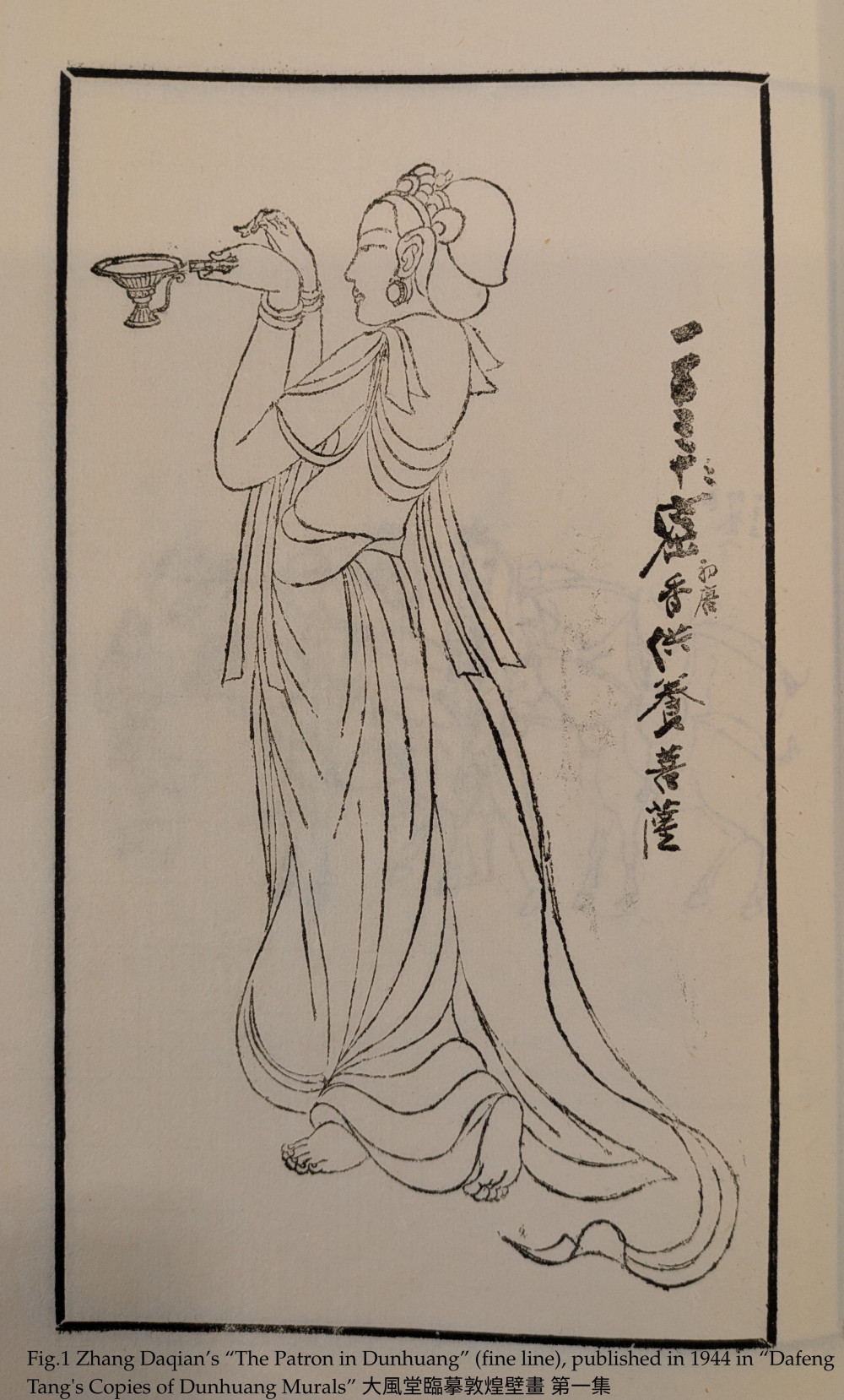
Zhang Daqian’s “The Dunhuang Tribute Bearer” in the 1944 publication Dafeng Tang's Copies of Dunhuang Murals. Leiden University Libraries Special Collections (SINOL. Gulik E 257.1).

Rongbaozhai: The Art of Woodblock Printing

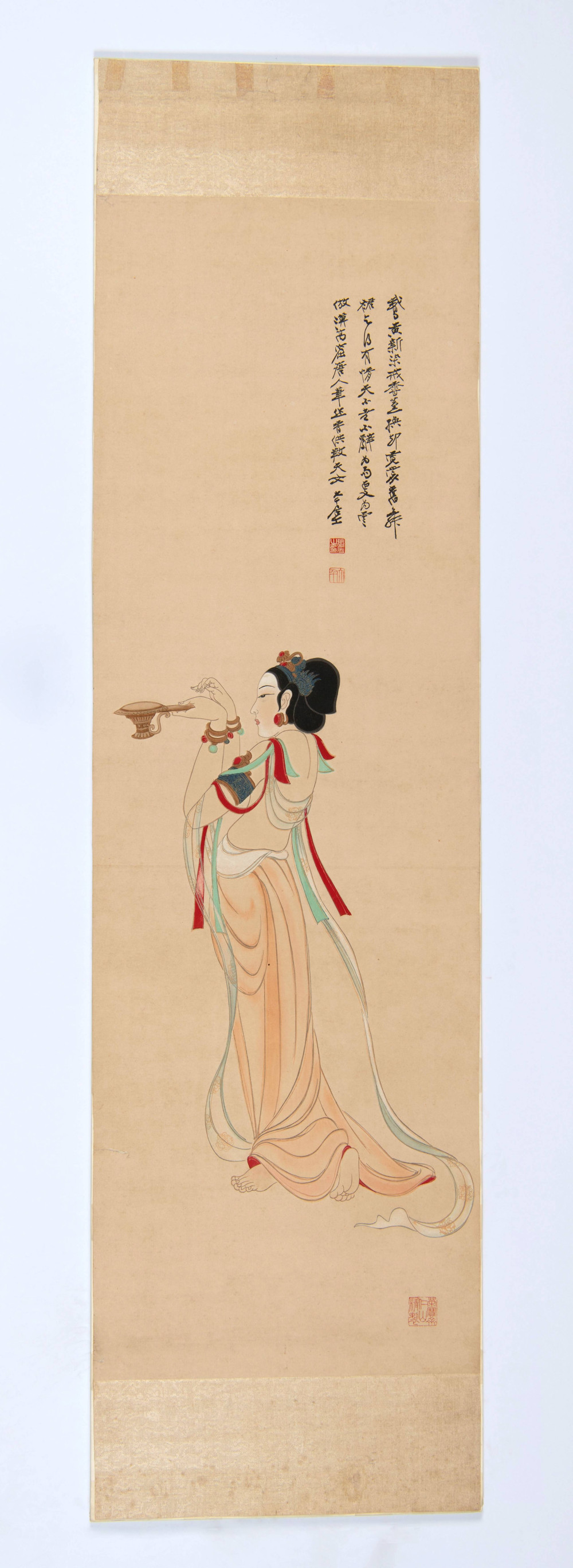
The colored version of “The Dunhuang Tribute Bearer” was first reproduced as a full-sized mubanshuiyinhua (water-based woodblock print) in 1945 by Beijing’s Rongbaozhai 榮寶齋 (est. 1672), a stationery and woodblock print studio with which Zhang Daqian had a close relationship. During the printing process, multiple woodblocks are used to apply colours in layers (a technique developed in Ming Dynasty China in the early seventeenth century). By varying the amount of water applied to both the printing block and the print, the tonal gradations in mubanshuiyinhua are so delicate that these woodblock prints can easily be mistaken for paintings. 

Initially, only small block-printed paintings could be produced, such as decorated stationery. But following two years of experimentation, “The Dunhuang Tribute Bearer” became the first large-format work that matched the dimensions of the original painting, measuring 132 x 36 cm. In the years to come, Rongbaozhai would continue to perfect its water-based woodblock printing technique, which was granted the status of Chinese Intangible Cultural Heritage by UNESCO in 2006. The Wereldmuseum holds a Rongbaozhai water-based woodblock print of “The Dunhuang Tribute Bearer” that was once in the collection of the Dutch diplomat and sinologist Robert van Gulik (1910–1967). 

Rongbaozhai’s water-based woodblock print of “The Dunhuang Tribute Bearer”, c. 1945–1964. Wereldmuseum (7304-7)

Artful Diplomacy and PRC propaganda

Following the civil war between the nationalist Guomindang and communist army led by Mao Zedong who proclaimed the People’s Republic of China (PRC) in 1949 on mainland China, the Republic of China (ROC), relocated to the island of Taiwan. Within the geopolitical context of the Cold War, particularly after the outbreak of the Korean War, the United States continued to recognize the Republic of China (ROC) as the sole legitimate government of China. This political position was closely tied to the ROC’s claim to be the authentic inheritor of Chinese art and cultural traditions. In response, the People's Republic of China (PRC) likewise sought to assert its own cultural continuity with the Chinese nation through art. 

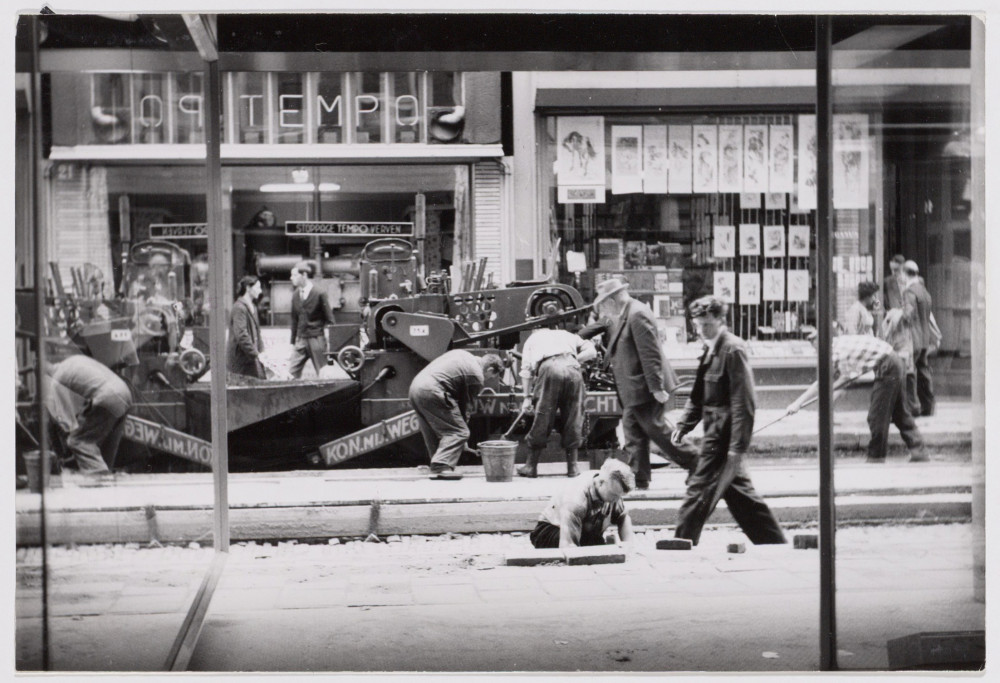
Under the PRC government’s directive, Rongbaozhai’s prints were frequently presented as state gifts to foreign officials to represent the new arts produced by communal effort of the young People’s Republic. The prints were also disseminated abroad through communist bookstore networks. For example, Amsterdam’s bookstore Pegasus, established by the Communist Party of the Netherlands (CPN) in 1934, imported numerous Rongbaozhai woodblock prints and PRC propaganda materials between the 1950s and 1960s. The bookstore also organized regular China Week events and exhibitions in which these imports were displayed and sold. In one such exhibition in 1958 at the CPN’s then headquarters on the Keizersgracht in Amsterdam, Felix Meritis, a Rongbaozhai copy of “The Dunhuang Tribute Bearer” was exhibited.

Pegasus (store on the right) on Leidsestraat in Amsterdam, with shop window showing Chinese woodblock prints, c. 1960. Stadsarchief Amsterdam (OSIM00005005499). Nederlands Fotomuseum, KVB-00551

The Chinese Cultural Chests and ROC Propaganda

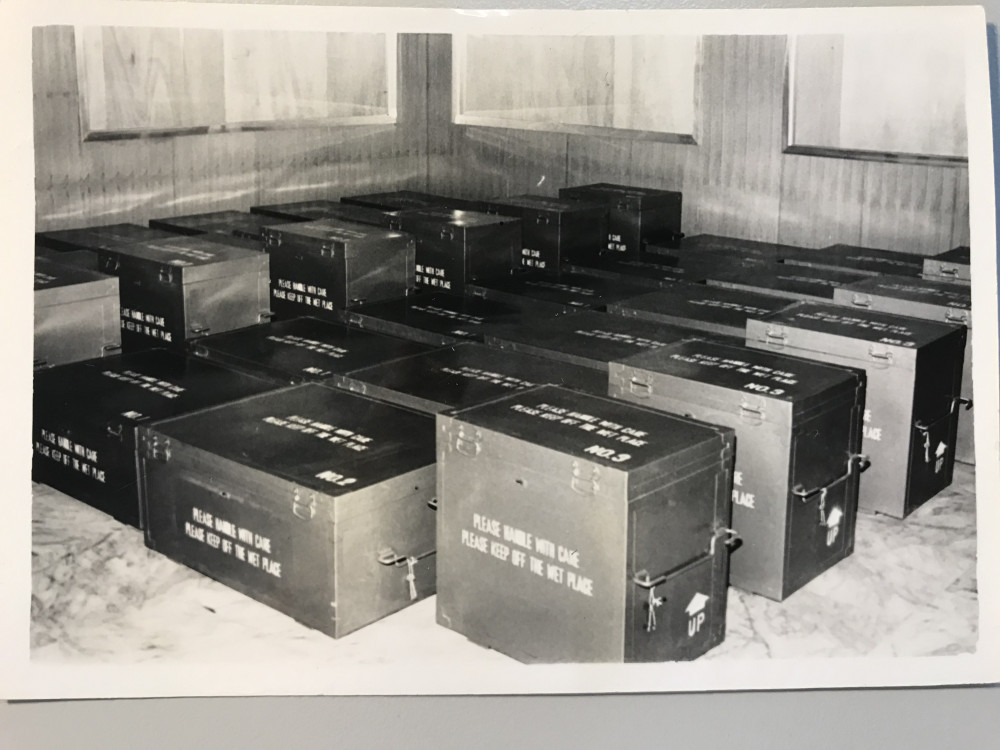
The early 1970s marked a watershed moment. It was an especially difficult period for the ROC following its withdrawal from the United Nations in 1971, when its seat was transferred to the PRC, and the subsequent wave of countries severing diplomatic relations with the ROC. As part of its efforts to maintain its claim to representing Chinese culture internationally, the ROC's Ministry of Foreign Affairs commissioned the National Museum of History in Taipei to produce the so-called Chinese Cultural Chests 中華文物箱Between 1969 and 1986, the Chinese Cultural Chests were produced in five instalments, each containing a different selection of items, primarily fine reproductions of ancient bronzes, porcelain, lacquerwares, rubbings, traditional and modern paintings. The chests were distributed to overseas missions, where they were presented to guests and exhibited during festival occasions. 

Reproductions formed the majority of works included in these chests. Given the precarious geopolitical situation, sending original artworks abroad for display was considered too great a risk. Therefore, during the early stages of the Chinese Cultural Chest project, the chests consisted almost entirely of high-quality reproductions. Only from the late 1970s onwards were original contemporary calligraphy and paintings, specially commissioned for the chests, added. 

Many of these reproductions were based on artworks relocated from China to Taiwan by the ROC government after 1949, which are now held primarily in the National Museum of History and the National Palace Museum in Taipei. Others reproduced works from private collections, including Zhang Daqian’s “The Dunhuang Tribute Bearer.” 

In August 1970, the first instalment of Chinese Cultural Chests was placed in the basement of the National Museum of History, awaiting shipment to the United States and Belgium. © National Museum of History, Taipei.

Ambassadors on Paper

Zhang Daqian left China after 1949 and eventually settled in Taiwan in the 1970s. He authorized the museum to replicate many of his paintings for inclusion in the Chinese Cultural Chests. Zhang’s prominent reputation in the art world, together with his amicable relationship with the National Museum of History, resulted in the “Modern Chinese Painting Reproductions” category in the first batch of Chinese Cultural Chests being composed entirely of his works; subsequent batches likewise continued to include reproductions of his paintings. 

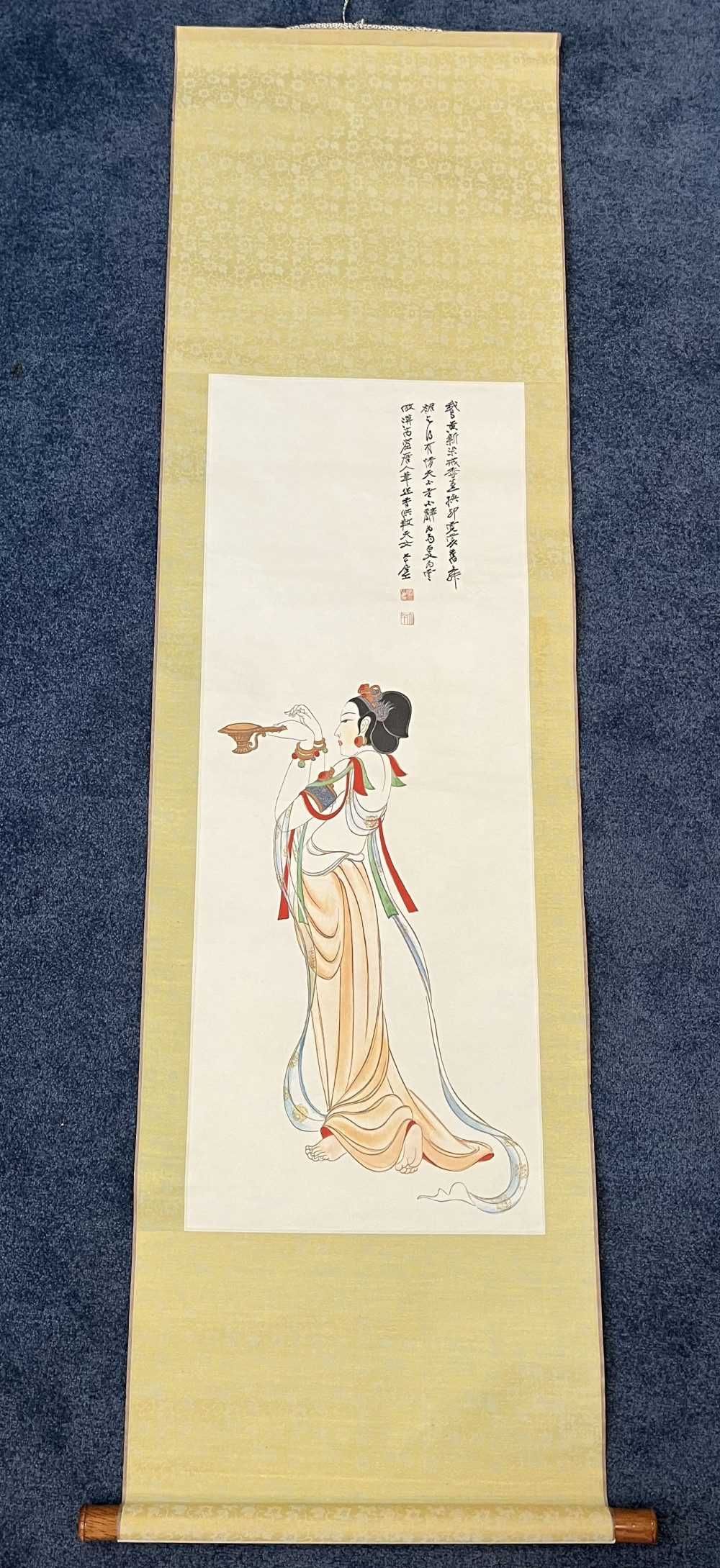
Different from Rongbaozhai, which reproduced “The Dunhuang Tribute Bearer” using water-based woodblock printing, the National Museum of History commissioned private printing firms to carry out the production, using offset lithography for image transfer. The process involved first capturing photographic reproductions of the original paintings, after which the images were printed onto paper using oil-based inks.  

The production of the Chinese Cultural Chests concluded in 1986, following the steady strengthening of local identity consciousness in Taiwan. As witnesses to this bygone history, many of the works circulated through the chests remain today in Taiwan’s overseas offices, including “The Dunhuang Tribute Bearer”. 

Reproduction of “The Dunhuang Tribute Bearer” for the Chinese Cultural Chests, now collected in Le Centre Culturel de Taïwan à Paris.  © Le Centre Culturel de Taïwan à Paris
Reproduction of “The Dunhuang Tribute Bearer” for the Chinese Cultural Chests, now collected in Le Centre Culturel de Taïwan à Paris. © Le Centre Culturel de Taïwan à Paris

Would you like to know more about the Dunhuang caves?

You can also visit the caves digitally here.

About the author

Pao-Yi Yang (Ph.D. Leiden 2021) specializes in the collection and exhibition histories of Chinese art. She was provenance researcher at the Research Center for Material Culture in Spring 2023 (funded by the Vereniging Rembrandt). Her publications appear in journals such as Museum & Society, Journal of Curatorial Studies, and Journal of Visual Communication

Would you like to know more about reproducing Chinese ink drawings? Read more in the story Chinese houtblokdrukken (Dutch only).