Afrikaaps 101 with Jitsvinger

Jitsvinger. Fotografie door Newton Stanford

Music has the power to carry history, identity, and resistance all at once. In this article, we explore decolonisation through sound, focusing on an artist who challenges dominant narratives through language and rhythm. 


Our guide in this exploration is Quintin Goliath, aka Jitsvinger— a multi‑award‑winning performing artist from Cape Town and the originator of Afrikaaps. Track by track, he unravels the ideas, wordplay, and layers that shape his work.

Meet Jitsvinger

Growing up on the Cape Flats—a region shaped by forced removals under apartheid and persistent misrepresentation—Jitsvinger's engagement with words began early. What started as playful experimentation, freestyling with friends and exploring rhythm and sound, gradually revealed the political and poetic potential of language. Now working as a writer, composer, poet, performing artist, and educator, Jitsvinger moves fluidly between disciplines. Central to his practice is Afrikaaps, a term he coined to reframe Afrikaans as a language shaped by marginalised communities, rather than colonial authority alone.
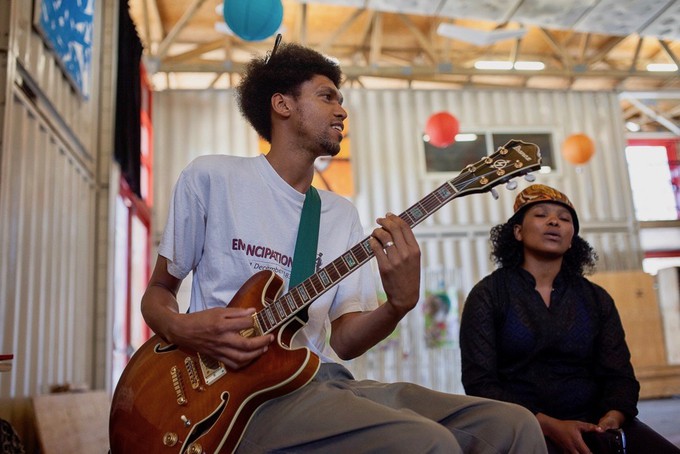
Jistvinger tijdens repetities. Achter hem zit Nomapostile Nyiki. Foto: Ashraf Hendricks
Photo: Ashraf Hendricks

Identity - Benjamin Jeptha feat. Jitsvinger & Eden Myrrh

Jitsvinger: "This track starts with questions. Real questions—about who we are. “What is the value of our skin? The language we speak? The culture we embrace?” It’s about confronting identity. Because a lot of what we think we are comes from someone else’s vision. So the song challenges that—it brings a new definition, a better knowledge of self.

The line “in opstand met die tong van ’n bom, plant dit in die kop.” refers to rebelling with the tongue. Language is powerful. What you say, how you say it—it plants something in people’s minds. It can explode, it can shift perspectives. So for me, it’s about using language as a tool of resistance, but also of awareness. Once something is planted in the mind, it grows."

Jitsvinger - Breinsuiker feat. Akwasi

Jitsvinger: "Breinsuiker is like… mental sweetness. Not just surface-level attraction—it’s about being drawn to someone’s mind. Someone who stimulates your thinking. “Niemand het ’n smaak soos jy nie”—no one tastes like you. It’s rare. It’s about connection through thought—someone who challenges you, who makes your mind move freely".

Skiroemba - Jitsvinger feat. Youngsta, Monox

Jitsvinger: "The wordplay in my music starts with the beat. You listen first—what kind of rhythm, what kind of movement is there. Then the words come. I play with them—Afrikaans gives you that freedom. You can bend it, stack sounds, create textures. Sometimes it’s not just about meaning—it’s about how it hits. The sound, the rhythm, the repetition."

“Hoe Lyk Hulle” - Jitsvinger feat. Roksha

Jitsvinger: "This song is about unity. “Saamstaan issie movement”—standing together is the movement. Whether it’s live shows, CDs, cassette, whatever format—it’s about bringing people together through music. And the title—Hoe Lyk Hulle (literally: 'What do they look like') refers to recognition. Who are “they”? What do they represent? It’s about seeing yourself in the movement, in the people around you. And also celebrating what’s good. Because nowadays, people are so focused on negativity, especially on social media. We forget to look up, to appreciate. So the song is also about bringing something positive into the space—what do you bring to the table?"

Language, identity, and storytelling from the Cape Flats

Read the full interview and learn more about Jitsvinger’s artistic journey and his relationship with language.